Thursday, January 29, 2009

Update Coming


I have a lot I want to write about here, when I get a chance...Obama, world affairs, etc., I can't believe I havent' added anything in 10 months!!


Tuesday, March 18, 2008

Passing the Time

Not That I'm Counting Down!

Its been a while huh? No real reason, other than not feeling like writing, I apologize for those of you who read regularly and are tired of visiting only to see me and Santa Clause, I guess I need one with St. Patrick, or the Easter Bunny. Since I last wrote, so much has happened, but at the same time, nothing has changed. I don't usually write about my personal affairs on this blog, but I will share that on January 23rd Mary and I were blessed with the arrival of our daughter, Anne Elizabeth. Since then everything I am doing over here takes a back seat to simply making it home safe. I understand that's not a great way to spend 90 days of your life, waiting for a date on a wall to arrive, but that's the way it is. Lately we've been preparing to recieve the next team, updating records, accounting for property etc., etc., As a result our advising and training role has taken a back seat, therefore, no fun adventures, just time, ticking by.

When's Dad Coming Home??


Sunday, November 25, 2007

Happy Thanksgiving


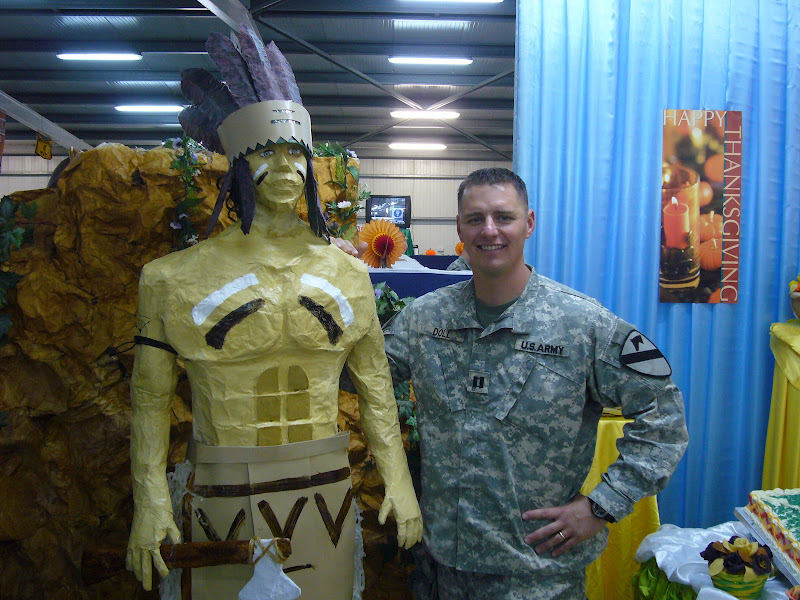
Well, we just celebrated Thanksgiving here at FOB Sykes, my third Thanksgiving in the Middle East in the last seven years. As always the food was outstanding, but nothing compares to being home and seeing the people you love. I even treated myself to a cinnamon roll for breakfast, but no-one comes close to Mom's cinnamon rolls. Unfortunately, being 8 hours ahead of the United States means that alot of Thanksgiving traditions don't really work, for example...The Macy's day parade started at 4 p.m. here, the first football game came on at 8:30p.m. But the chow hall did a great job in preparing a feast, and doing what they could to make us feel at home.


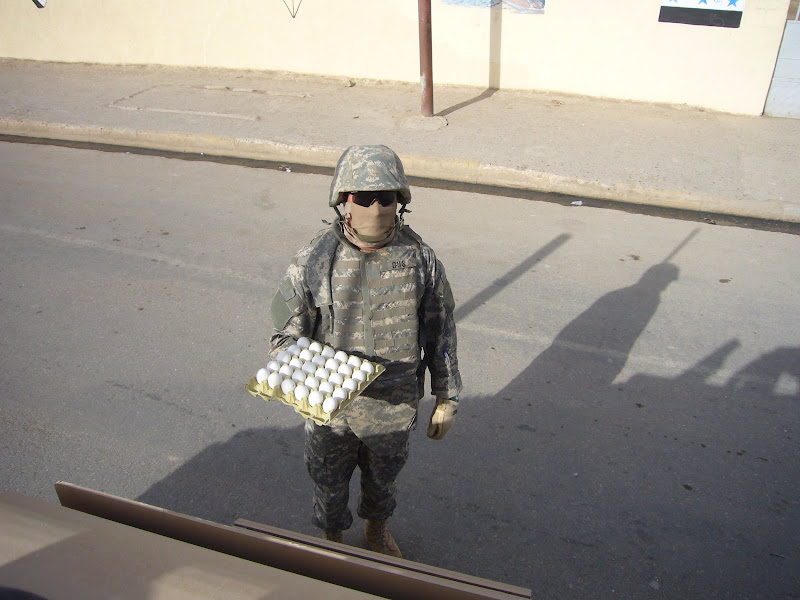
Interpreter "Gus" picking up some eggs in downtown Tal Afar


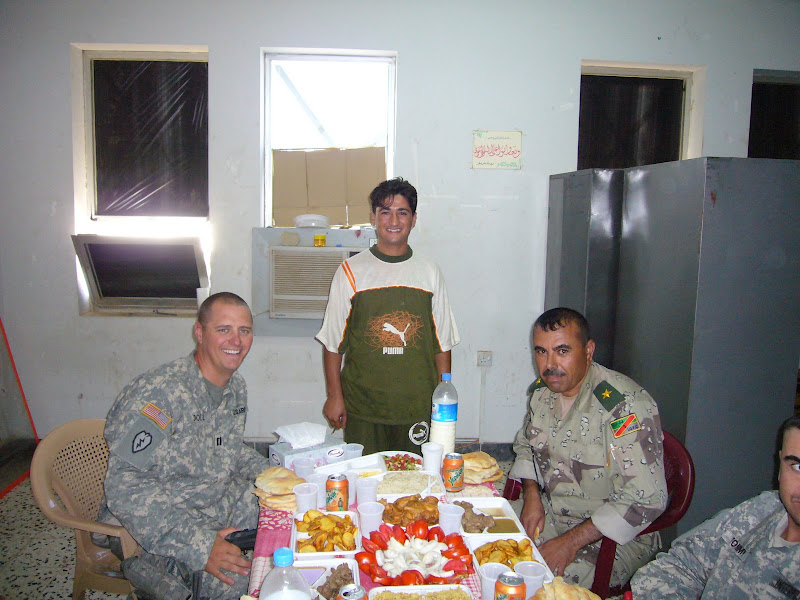
IRAQI FOOD SERVICE
I've decided to use the occasion of a big Thanksgiving feast to continue my series of posts about Iraqi Logistics, specifically food.
When talking about Iraqi Army Logistics, or just the Iraqi Army for that matter, its helpful to first try to explain or understand how things are supposed to work, and then step back an look at how things are actually working. The Iraqi Ministry of Defense has published policies and procedures for how nearly everything is supposed to work. In most cases these regulations read remarkable similar to U.S. Doctrine, unfortunately, the Iraqi culture is much different than the U.S. culture. One quick example, in my efforts to get to the bottom of how food service was supposed to work, I needed to have a contract translated from Arabic to English. Working with one of my interpreters, we sat down to start pulling out the pertinent information, repeatedly he translated the requirements of the contractor as "The contractory should to X, Y or Z" I kept'saying, "Harold, I know the contract doesn't say 'should' it says 'must' or 'will' 'right?," No sir, it says "should." And that is the Iraqi way, as they say..."Inshalla."


How it's supposed to work:

The Iraqi Army enters into a Life Support contract with a civilian contractor to provide all food service requirements. The contract calls for 3 prepared meals each day, with suitable variety, freshness and nutritional value. The life support contract also includes provisions for cleaning services, laundry services, and building maintenance, among others. Essentially, the life support contractor is required to provide most quality of life support for the Iraqi Junood (soldiers.) Each month, the Iraqi Army Battalion S-4 (logistician) is required to submit a Life Support Contract Quality Assessment. This assessment rates each contracted commodity area by percentage and is used to compute how much of the contracted dollar amount the contractor is paid. For example, if the contractor only provided lunch and dinner for the unit, he will only be paid 2/3's of the contracted amount for food services.


What really happens:

First of all, you have to understand that the Life Support Contract was written with certain assumptions, the most important being that the Iraqi Army unit being supported was stationed, or operating out of some sort of permanent base, a base with a dining facility, or at least a central location where food could be prepared. Unfortunately, one of the key principles of counterinsurgency is that security forces live among the people they are protecting. For our IA battalion, this means that we have upwards of half a dozen combat outposts where Soldiers are living and operating 24/7. So, obviously a contractor isn't going to establish a dining facility at each of these small bases, nor would it be feasible to prepare the meals at a central location and deliver them to each of these bases. The solution the Iraqis have come up with is that the contractor only delivers uncooked "groceries." The IA convoys to a central location every 3 or 4 days to pick up the food and then Soldiers cook the food for their units. Sounds like a good solution right? It could be, here are some of the problems:
  • Site Selection. The centralized location chosen by the IA is a U.S. Fob. Force Protection requirements for U.S. bases are very strict when it comes to dealing with local national vehicles and personnel. The means that every truck is completely unloaded and reloaded before it can enter the base. Not only does this lead to long delays in convoys entering the FOB, it also results is bruised produce, meat being left in 130 degree heat for hours while the truck is unloaded and then reloaded.
  • Transportation of Food. The Iraqi Contractor who provides the food owns one refrigerated semi-trailer, it is used for storage on FOB Sykes. His food warehouse is located approximately 2 hours north of Tal Afar in the city of Dohuk. In order to restock on FOB Sykes, he must load food from his refrigerated warehouse in Dohuk onto a non-refrigerated semi trailer, negotiate numerous Iraqi checkpoints on his drive south, any one of which may require him to unload his cargo for inspection, then pass through the gates at FOB Sykes, another cycle of downloading and uploading. All told, the food my be outside of refrigeration for upwards of 8-10 hours. Not a big deal in November, but meat left outside for 8-10 hours over here in July or August would probably be cooked Medium Well by the time it made it back into refrigeration.
  • Food Storage. Most of the combat outposts are not equipped to store large quanitites of food. Rations are stored on the floor, or in soldiers quarters, or next to the latrine. Refrigeration is also limited at these locations. Most of the COPs have freezers, however when the city power is only on for 8-10 hours per day, cold storage becomes a challenge.
  • Cooking Fuel. The life support contract provides barely enough fuel to adequately prepare the food. Some weeks the IA is forced to purchase cooking fuel on the economy in order to prepare their food.
  • Portability. While often lamented by American Soldiers, the meal ready to eat, or MRE allows the military to conduct days or weeks of operations without worrying about food. One MRE provides more than enough calories to sustain a soldier for 24 hours. The Iraqi Army has no such equivalent. In order to perform "out of sector" missions, they must pack enough groceries, fuel, pots pans, stoves etc, etc, in order to sustain themselves.


These are just a few of the challenges which are confronted every day just so the Soldiers can have enough to eat. But, perhaps the biggest one is corruption and bribery.

I'm really not sure how to introduce the story, I'm not sure how prevalent things like this are throughout Iraq, I only know what happened in our case. Due to the deployment of the IA throughout the city, our battalion was consistently rating the contractor as only fulfiling approximately 20% of his contract. However, each month he was getting paid as if he were fulfiling 100% of his contract. When coalition forces along with the IA looked into it further it was discovered that although the customer units, i.e. the battalions, were consistently reporting that the contractor was not fulfiling nearly 80% of his contracted resposibilities, by the time the reports were recieved at the MOD in Baghdad, it appeared that he was being rated 100%. Obviously someone was doctoring the assessments, ensuring the contractor was getting paid much more than he should have. In other words, some Iraqi official was being paid off to doctor official reports. Another interesting story regarding the contractor, after this bit of corruption was revealed, a new contract was put out for bid, the old contractor did not renew his bid, or so it seemed, when the winning bidder was revealed it turned out to be the same contractor, he simply changed his company's name.
Wednesday, November 14, 2007

The "Other Iraq"


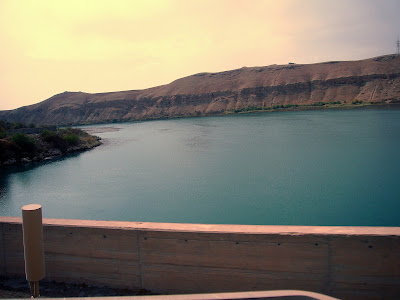
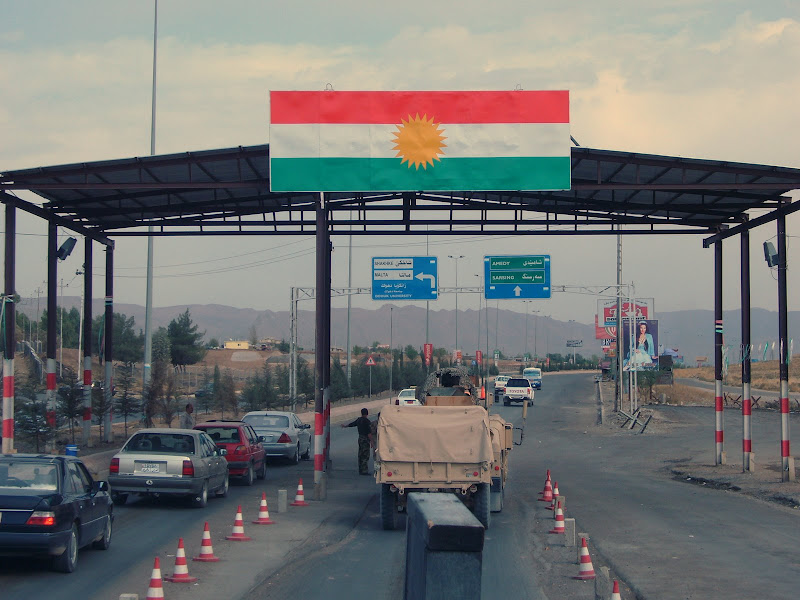
We recently took a trip to a city in Northern Iraq called Dohuk. A city of approximately half a million people, it is set in a valley surrounded on three sides by mountains. As one of the largest cities in the autonomous region of Kurdistan its citizens have enjoyed unbelievable prosperity since the fall of Sadaam. We went to Dohuk to do some shopping for our IA counterparts, there are some things that are hard to find in Tal Afar. After about a two hour drive North, past the precarious Mosul Dam,

we passed a Peshmerga checkpoint, signalling the fact that we were now in Kurdistan.


Once into the city of Dohuk, we left our HMMWV's, Body Armor and Machine Guns at a Peshmerga Military Base and our hired drivers drove us in Land Rovers and new Toyota SUV's to our Hotel.

As we pulled up in front of our Hotel, the first car we saw was a Hummer H2, the first luxury SUV I had seen in over six months, it soon became clear that it wasn't an anomoly however as Infinities, Porches, and numerous BMWs cruised by the hotel within the first 10 minutes of being there. Obviously this was a little different than we were used too.
We spent three two nights in the city, and were treated like celebrities the entire time. I've never had my picture taken so much. A quick taxi ride or a short walk could get you werever you needed to go. I guess I'll just share some pictures now.

Sunday, October 14, 2007

My Commute

Here's a video from a trip out to COP Destroyer, it shows what I see from my HMMWV Turret, I'm usually the rear truck gunner responsible for rear security, so I always see everything go by. I put some music over the usual sound because listening to a HMMWV engine for 10 minutes isn't that exciting. A couple things you can see: A Holstein cow in the back of a pick up truck. A herd of sheep walking down a busy street. Tractors, Donkey carts and cars. Have a look.


Monday, October 08, 2007

A Few Thoughts on "Phony Soldiers" and Blackwater


I know my next post is supposed to cover more IA Logistics, specifically how food water and ice is handled, but I wanted to write a bit about a couple of issues that have been in the news lately; Rush Limbaugh's comments about phony soldiers and the recent Blackwater incident in Baghdad.

I haven't seen or heard Rush Limbaugh's comments in full, only what has been either lambasted by democrats or defended by Fox News Pundits. I can only say that to call someone who opposes this war while fighting it phony is a dangerous premise. I'm sure that those of you who read this blog regularly can figure out that I am opposed to this war. I feel that it was wrong of us to invade Iraq. I am tired of the ever evolving change in reasons to continue this war.

  • 9/11,
  • WMD,
  • Civil War,
  • Promote Democracy
  • Give Petreaus a Chance
  • The Surge is Working
  • I'll be Out of Office in a Year or So, Let Somebody Else Deal With It
  • Don't let Iraq Become a Haven For Terrorists


I am ashamed of the way it has made our country look in the eyes of much of the world. I am disheartened by our continuous lack of social and cultural "grace" when it comes to understanding other areas of the world. I am frustrated by an unwillingness of an organization to realize that the cold war is over and no enemy will again stand toe to toe to the United States. I am saddened by the loss of too many fathers, sons, brothers, mothers, daughters and sisters.


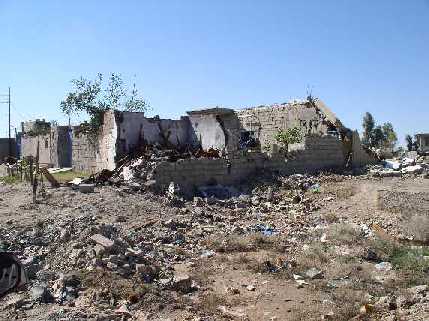
So, does this mean I am a "phony Soldier" I'm sure by some standards it does. It is impossible to judge what happens over here from the comfortable studios of the EIB network. It is impossible to come over here and see the destruction and suffering and not have my eyes opened. Every day, I am forced to look at all the remnants of war which remain in the city. The barriers, wire, checkpoints, abandoned buildings, bullet holes in buildings, crumbled homes, all a result directly or indirectly of our invasion. In my current role, I can feel some sense that what I am doing is critical to ending this war. Soldiers do not make policy, Soldiers do not make war, a Soldier's role in war is to advise the civilian leadership of this country and to execute the decisions made by that civilian leadership. I feel that if a few more "phony Soldiers" had stood up to Cheney and Bush and Rumsfeld, this situation could have been avoided. The president has continued to surround himself with "yes" men. If your closest advisers are "yes" men, it goes without saying that they are redundant and irrelevant. I like to hear people tell me I'm right as much as the next guy, but people in leadership should be more concerned with making sound decisions than to prove that they are the "decider."


A Phony Soldier?

I just wanted to touch on the Blackwater controversy quickly to clear up what I see as misconceptions and to add my two cents. If you follow this story you will hear alot of numbers thrown around concerning contractors and their level of participation in this war. Private security companies do provide armed security on numerous operations. FOB Sykes is guarded by a Turkish security company. Don't think though that contracted security forces outnumber or even approach the numbers of Soldiers, Sailors and Airmen in country. The numbers thrown about on talk shows and other media reports include cooks, bus drivers, crane operators, etc., many of whom are from countries other than the United States. I would estimate that 80% of the contractors on FOB Sykes are from India or Pakistan. They do everything from cleaning bathrooms, hauling garbage, and driving buses, to cooking food, and maintaining HVAC equipment. A private security contractor is very well paid, earning as much around $12,000 a month. The majority of the TCNs (Third Country Nationals) earn less than $1,000 a month. Considerably less than what it would take to pay and equip a soldier to do the same work, but well above the average monthly wage of Pakistan or similar countries. To say that we are privatizing the war is simply, from my point of view, false. The majority of contractors are poorly paid (by U.S. Standards) and provide services which would seem ridiculous to have soldiers perform.

However, I feel that firms such as Blackwater, Aegis and others, are detrimental to what we are trying to accomplish over here. To allow them to continue to operate outside the law is an unfathomably bad idea. Iraqi civilians don't discriminate between contracted security officers and the Military. A violent act commited by Blackwater no doubt leads to hostile actions and feelings against the military. It is time that the State Department of the U.S. Congress takes action to change their lawless behavior.


Click here to take Rush Limbaugh off Armed Forces Network

Monday, October 01, 2007

The Challenge: Logistics


CPT Doll in a Russian Kroz

"An Army marches on its Stomach" This famous quote is attributed to Napoleon Bonaparte, the famous Frenchman who recognized that logistics is often more important than tactics in winning a war. Perhaps the single greatest factor in the world-wide dominance of the United States Armed Forces is our ability to project our power across the globe. This would not be possible without our mature, robust and unprecedented logistics system. As a transportation officer, I have the ability to track a part from its production in a factory until it is delivered to the user on the battlefield, utilizing numerous computer systems and the world wide web. I have the ability to communicate directly with the operator of the vehicle which is carrying the part in case it needs to be diverted or is no longer needed. As a country, we have spent billions of dollars on technology and systems which enable us to get the right part to the right place at the right time. Some claim that "Amateurs study tactics, professionals study logistics." So, it is with great frustration and often disbelief that I have been exposed to "The Iraqi Logistics System." The motto of the Transportation Corps, corny as it may be is "Nothing happens until something moves" The motto of the Iraqi Logistics system could be "Nothing happens until some general in Baghdad says its o.k., but he's probably on leave, so you need to wait a week." I figure the most logical way to explain what we are dealing with is to cover the overarching problems which factor in to all logistical operations, then, in another post, I'll cover the "eaches" by going through each class of supply and explain our challenges. As the logistics adviser, I am directly responsible for developing and improving the logistics leaders in our IA Battalion. Thus far, it has taken me almost 4 months of being on the ground just to wrap my head around how things are supposed to work and how they are in fact working.
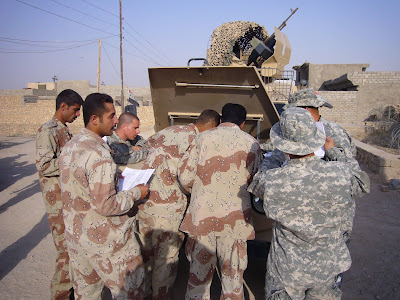

Maintenance Training at Cop Destroyer

  • An Immature System: When we dismantled the Iraqi Army after the invasion, (against Bush's Orders...he thinks, its hard to remember) the entire Army was summarily dismissed. As we realized that we were facing an insurgency, and the Army would need to be rebuilt, we began by building from the smallest level. First squads, then platoons, then companies, battalions brigades and so on. The Ministry of Defense wasn't even an Idea. I have a colleague here who was a Tank Platoon Leader in OIF II, (we're now in OIF VI) who remembers as the ICDC (Iraqi Civil Defense Corps, a precursor to what is now the Iraqi Army) was being formed, he would be tasked to take Iraqi Security Forces on patrol with him, he would stop by their compound in his tank and pick up three or four, and they would ride out into the city with him on patrols. I tell this story to tell you this, for the first 3 years of Iraqi Security Forces, coalition units provided them with all of their logistics support. We bought their AK-47's, Pistols, and Ammo. We provided them with fuel, barriers, uniforms, everything. While this was effective in establishing them as a fighting force, it only contributed to their logistical dependence on Coalition Forces. Since then, its been an constant uphill battle. In each division there is a logistics company called the Motor Transport Regiment or MTR.

Destroyed Russian UAZ vehicles sit at Al Kisik

By design they are supposed to provide maintenance and transportation support to the three Brigades in the division. This unit has received its vehicles and theoretically should be capable of executing its mission. However, they have yet to complete a convoy to the National Depot in Taji, and are barely capable of getting even one truck to leave their post and deliver anything. Their maintenance company only last month submitted the list of parts that they need to stock, and they have yet to fix a single truck.
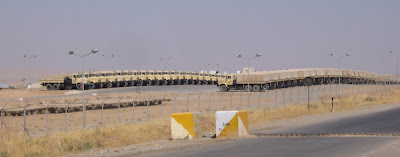
Russian Kroz Trucks at Al Kisik
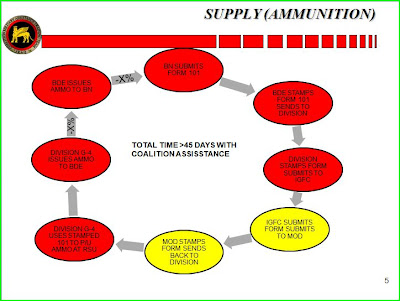
  • Centralized Control: In order for anything to get accomplished in the Iraqi Army, be it tactical operations, promotions, and is seems especially logistics, an Iraqi Officer must be ordered from higher. Initiative and innovation are not rewarded as they are in many cultures. This leads to huge headaches when trying to get supplies such as ammunition etc. Just a quick example which I'll probably reiterate when I discuss Class V: Here's the flow just to receive ammunition, keep in mind that there are millions of rounds in a warehouse not 30 minutes drive outside of Tal Afar where our Battalion operates. Also, IGFC (Iraqi Ground Forces Command) and MOD (Ministry of Defense), are located in Baghdad. A parallel system in the U.S. Army would involve a request for ammunition being approved by two bureaucracies within the Pentagon. Absolutely ridiculous, and the most frustrating part is that it is this way with nearly all supplies. I've attached a power point slide I created to brief my MiTT Team Chief on why our Battlion was struggling so much logistically.


Iraqi Ammunition Resupply Process

    Next Time: Class I; Food Water and Ice
Monday, September 24, 2007

The Challenge: Fear of Infiltration


I suppose I’ve expressed enough of my political views in the last month to last a while, I think the situation over here is amazingly complex and history may or may not reveal the truth. But, I suppose it doesn’t matter, whether this war was conceived on deceit, or a genuine belief that things would turn out differently (even if plans weren’t made to ensure anything.) I am here, will be here for at least the next seven months, and regardless of how quickly the democrats promise to bring home the troops if elected, American Soldiers will be advising and developing the Iraqi Army for the foreseeable future. Over the next couple of weeks or so, I plan to write a series of posts covering the challenges that face us as we assess, advise and assist our Iraqi Partners.


Overall, our Iraqi Battalion is quite capable of day to day operations. They man their checkpoints professionally, the leadership is comprised of mostly former members of the Army under Sadaam Hussein. The sectarian divide that gets so much publicity doesn’t seem to exist for us, we have a very good mix of religions, Sunni, Shiite and Yezidi, and a good mix of Arabs and Kurds as well. I’ve never witnessed nor heard of a disagreement which stemmed from sectarian differences. Many Battalions are reported to be infiltrated with insurgents, and that may well be the case with ours. We are careful to never let our guard down when we are with the IA, we never leave our house without a loaded 9mm piston on our hip, though I’ve never felt threatened.


Because of this possible insurgent infiltration, mission planning is very compartmentalized at the higher levels of the Battalion. In the U.S. Army, mission planning is done both from the top down and the bottom up, the Iraqi model is different. The BN Commander may call his company commander on the cell phone and tell him to report to HQ, he will then tell him to have 4 HMMWV’s ready to go in ½ an hour. This is all the info the Company Commander will get out of fear that the target of the raid may be his brother, uncle, cousing, tribesman or someone he knows and he will tip them off. This compartmentalization results in little development of Junior Leaders, they are simply told what to do. Also, the lack of prior knowledge of a mission precludes the Company Commander, who is leading the mission, from doing any type of reconnaissance or detailed planning; only very generic basic rehearsals can be conducted. For example, if you know exactly what house you are targeting, you can plan your ingress and egress routes, determine where to best position your cordon, and identify most likely enemy avenues of approach and escape. All of these are key things to be familiar with before a mission begins and our Iraqi Company Commanders, Platoon Leaders and NCOs are force to operate without them. This leads to numerous raids resulting in what are referred to as “dry holes.” Because escape routes aren’t sealed off before the cordon is set, the targeted individual is able to sneak out of the area.


Next time I’ll write about the logistical problems our BN deals with on a daily basis.

Wednesday, September 19, 2007

A Multiple Choice Exam


These four scenarios are equally unbelievable and ridiculous, one of them just happens to be true. Just to help you, i've italicized the right answer.

The Federal Government has implemented one of the following plans in order to create positive spin for a failing policy. Pick One.

  • The Dept. of Energy has plans to raise the price of gasoline to $4.00 per gallon for six months, then the price will be dropped to May '07 levels, they will then take credit for lowering the price of gas.
  • The Border Patrol will allow the next 50,000 illegal immigrants to walk across the border unchallenged, in six months they will round up 50,000 illegal immigrants and deport them, claiming progress in securing our borders.
  • The EPA is going to permit clear cutting 10,000 acres of virgin old growth forest in Yellowstone National Park, they will then replant the acreage, an environmental success story we can all appreciate.
  • Finally, we will increase troop levels in Iraq from a sustainable 130,000 to 165,000, then when troops are slated to go home, and there are no available forces to replace them, we will claim that due to an improved security situation, we are now able to begin a withdrawal of 35,000 soldiers over the next 4 months. Hey Hey, we're winning the war.


The Petraeus, Crocker hearings made for great entertainment, but I don't think they should be taken for more than that. The "decisions" that came about as their result were already made when the surge was first proposed. We couldn't maintain current troop levels here without doing something drastic. Like pulling even more troops out of Afghanistan, or extending tour lenghts to 18 months. The security situation in this country may be better than it was 4 months ago, but it is still much more dangerous for U.S Forces and the Iraqi people than it was a year ago.

Finally, here's a short clip of Juan Cole discussing what is happening in Al-Anbar. If you don't know by now, I think this guy really has his finger on the pulse of what is happening in Iraq. His latest headlines are always on the right side of this page. I try to read his blog every day. have a look.

Sunday, September 16, 2007

Three Years


Three years ago, my father died. Just to type these words is difficult, I think all who loved him are still struggling with the loss. How have three years passed? If you knew Thomas Doll, then you can appreciate the loss we all suffered three years ago. If you never met the man, then no blog post, no matter how well written could possibly explain what he meant to us.

Being in Iraq, away from loved ones, the comforts of home, security, predictability, I find myself constantly wondering what Dad would have thought about the situation here. I would give anything to sit and talk to him about all that I have experienced here in the 17 total months that I have spent in this country. What would he have thought of my role in the first elections in Iraq in January of 2005. What would his reaction be to hearing that the Dining Facility where I ate every day was attacked by a suicide bomber on December 21, 2004? What of the Turkish truck driver who lay bleeding on an Iraqi road while I tried to call for a medevac helicopter to come and pick him up. I wish I could have told him how I spent what would have been his 52nd birthday at the Combat Support Hospital in Mosul, sitting with one of my squad leaders SSG Mejia who earlier in the day had been blown up by an IED on a road I now travel 3 times a week, and whose eyebrows were singed off and his leg crushed by the HMMWV which came to rest on top of it.

I wonder what Dad would think of the world I now live in. Of the customs and courtesies that are part of my daily life. Of my stories of the Iraqi Army, of the dilapidated house we live in. He would certainly appreciate the way our house is rigged up to work, building codes and American standards be damned. I know he would like the stories about the farmers here, and the broken John Deere combines that are scattered through the country.

Not a day goes by that something doesn't remind me of Dad. He had a way of looking at this world in a way that few can Every new experience, tragedy success and blessing in my life makes me miss him even more.

Thursday, September 13, 2007

A 'Non Western' View of Things

This video presents a lot of numbers, just try to imagine this level of human suffering in the U.S.

Wednesday, September 12, 2007

A few movies

Here's a few movies for your amusement, let me know what you think.

Human Feces on my Boot


Just Back From a Dusty Mission


Chinook Flight to Mosul


Night Vision on the Roof of COP Destroyer

Tuesday, September 04, 2007

What If?

Ambassador Ryan Crocker and Gen. David Petraeus are slated to deliver their congressionally mandated progress report in a week, conveniently enough on September 11. I don't think there is really much of a question what the report will contain. By my estimation it will be a validation of the surge, it will champion the idea that violence is down across Iraq. Juan Cole at Informed Comment offers the following analysis:

If you compare each month in 2006 with each month in 2007 with regard to US military deaths, the 2007 picture is dreadful.

8-2007 77 8-2006 65
7-2007 79 7-2006 43
6-2007 101 6-2006 61
5-2007 126 5-2006 69
4-2007 104 4-2006 76
3-2007 81 3-2006 31
2-2007 81 2-2006 55
1-2007 83 1-2006 62

I mean, how brain dead do the Bushies think we are, peddling this horse manure that US troop deaths have fallen? (There are always seasonal variations because in the summer it is 120 F. in the shade and guerrillas are too heat-exhausted to fight; but the summer 2007 numbers are much greater than those for summer 2006; that isn't progress.) And why does our corporate media keep repeating this Goebbels-like propaganda? Do we really live in an Orwellian state?


The report will likely make the claim that political progress is slow but moving forward (the Iraqi parliament only recently returned from their summer vacation, apparently its hot in Baghdad in the summer.)

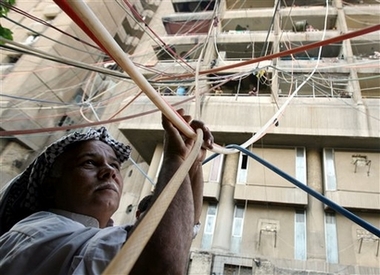
Crocker will brief that reconstruction efforts are taking hold, again a dubious claim at best, Baghdad has considerable less electricity than prewar levels, the city where I work, Tal Afar i only receives about 1/3 the electricity to power the entire city, so 2/3d's of the day the power is out.
Insurgents and militia's control many of the outer province electrical substations and in many cases have taken them "off the grid" thereby depriving Baghdad of power but giving their constituents power virtually all of the time.

One of the largest dams in the North, holding back 8 billion cubic meters of water is "in danger of imminent collapse." If this damn gives way, the city of Mosul and the American FOB Diamondback will be inundated, is there any doubt that recover and disaster relief operations would be a bit slower than those in New Orleans? I wonder what Mike "heckuva job" Brown is up to these days?


What if General Petraeus simply wrote the following:
Mr. President:


The United States Army and Marine Corps achieved their principal mission of overthrowing Saddam Hussein and his government. We did so with dispatch and minimum loss of life. We were then confronted with a massive insurgency which U.S. civilian officials, including yourself, did not anticipate and for which we have not been given adequate personnel and resources. There is little if any prospect of resolving this insurgency anytime in the next decade, if not longer. Further, continued engagement in Iraq's civil war distracts us from our most urgent mission in Afghanistan and erodes our stature in the world. Therefore, it is my recommendation that all U.S. forces be withdrawn from Iraq in an orderly but expeditious manner. In the event that this recommendation is not accepted, I have attached my letter of resignation from the United States Army.

David Petraeus

General, United States Army
Mr. Bush visited Iraq yesterday and stopped in Al Asad, an airbase in the once volatile, always newsworthy al-Anbar province. The al-Anbar has been in the news recently as a success story, local Sunni Tribeman have agreed to stop killing Americans and to focus their violence instead on AlQaeda operatives crossing the Syrian border. But to say that Al Anbar is peaceful and prosperous is simply propaganda. Consider the following:

IPS quotes a local Sunni cleric:

' "To say Fallujah is quiet is true, and you can see it in the city streets," said Shiek Salim from the Fallujah Scholars' Council. "The city is practically dead, and the dead are quiet.'


Watch this exchange between CNN's Wolf Blitzer and Republican Rep. Charles Boustany (R-LA)


Sunday, September 02, 2007

Attacking the Yezidis


The Yazidi's are members of one of the smallest religions in the world with between 200,000 and 300,000 members, primarily centered around Mosul in Northern Iraq, they have been the targets of catastrophic attacks in the recent weeks.

Suicide Bomb Kills 28 in Tal Afar
Iraqi Red Crescent says 500 killed in Yazidi attack


This has been significant for our team for a couple of reasons. First of all, 4 of our 5 interpreters are Yezidi, luckily all of their immediate family members were okay, but it still hit very close to home for them. Second, our IA battalion has responded to the tragedies by delivering food, water, clothing and other humanitarian items to the villages, and finally, the threat of huge dump trucks full of explosives pulling into town and blowing themselves up is particularly unnerving, especially when you consider how much time we spend living in the city. (See my post from March 29)

I'm not sure what news story pushed this carnage out of the American Mainstream Media, probably something as important as how to solicit anonymous gay sex while traveling through the twin cities. But whatever it was it pales in comparison to seeing the destruction in person

I encourage anyone interested in other religions to read further on this small religion. Some of the places mentioned in literature are very familiar to us here. Sinjar Mountain is to the West of our FOB and we watch the sun set behind it almost every night. One of our former interpreters, “Daniel” recently emigrated to Germany to link-up with his father where apparently there is an additional enclave of Yazidis .
Anyway, I took some pictures while we were in the village so I thought I would go ahead and post them here.

Saturday, September 01, 2007

COP DESTROYER


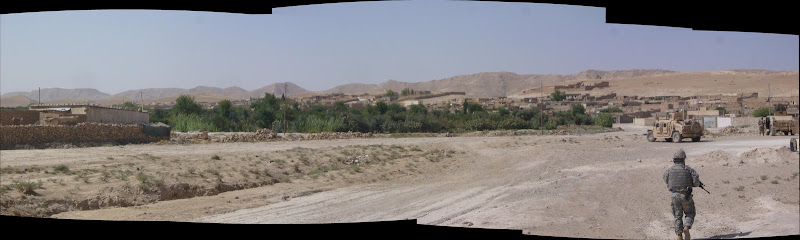
Like all high rollers, celebrities and famous athletes, Soldiers are accustomed to luxurious amenities and the red carpet treatment. So it should come as no surprise that we don’t limit our lifestyle to 160 square foot containers. Our MiTT team has a second home in the city of Tal Afar. Our Iraqi Army battalion lives and operates for the most part out of Combat Outpost (COP) Destroyer. We as their advisors spend approximately half of our time living with them in our house. COP Destroyer is on the outskirts of Tal Afar and consists of a bunch of abandoned houses which the IA has commandeered. It is protected on most sides by coils of concertina wire (razor wire) and concrete barriers. On one side it is open desert and on the other three sides the city of Tal Afar is close by. Our house sits on one side of the COP and overlooks both the desert and the city.
The house is fairly nice by Iraqi standards, substandard by American standards, it is constructed entirely of concrete, has concrete floors, and no indoor plumbing. There is one long room that runs the length of the house. It has three rooms off one side, two off the other and a courtyard out the back. We’ve converted one of the rooms into a kitchen with a microwave, deep freeze, toaster oven and a couple of hot plates. Another room serves as a “war room” where we store all of our gear (vests, helmets, weapons, and ammo) that we need to get out of the house in a hurry. The other rooms are sleeping rooms. The bathroom is a concrete structure in the back with a water tank on the roof. The “toilet” is an eastern style toilet which means it is a porcelain hole in the ground. The locals utilize it by squatting carefully over it (a comfortable position for them, as that is how they sit around a lot anyway), but we Americans are used to sitting not squatting, so we have a portable toilet chair, very similar to a training toilet for kids, we took out the pail and it now sits over the hole in the floor. After you do your business you simply pour about five gallons of water down the hole, and from there we really aren’t sure where it goes, though there is raw sewage flowing through the city and I guess some of that is ours. The other room outside has a shower head on the wall and a whole cut where the wall meets the floor, also there is a sink and a mirror for shaving etc.
Most Iraqi homes have flat roofs with a staircase to reach the top. Ours is no different. When the city power goes out or the AC isn’t working we typically spend the night on the roof. We have a machine gun mount up there and sandbagged bunkers at each corner “just in case.” It’s probably overkill but I guess you never know.
The biggest challenge to living in the house is the lack of consistent electricity. The TalAfar city power distribution substation rations the power to different neighborhoods throughout the day. Our house has power for about two hours at a time followed by two hours without power. In the past we had a large generator for backup power, but due to an incident the other night the generator caught on fire. Here’s what happened (names omitted to protect the innocent.) Late one night, a Captain and a Sergeant First Class were pulling guard duty. The generator was humming along happily but was running out of fuel. The CPT noticed that city power was on and decided to take the opportunity to refuel the sputtering generator, before he could make another move however the generator sputtered, coughed and died. No problem thought the Captain; I’ll just turn on the city power and go refuel the generator. So, he went to the back of the house and flipped a circuit breaker which allowed city power to once again power the house. This set into motion a series of events that ended our days of easy power. The normal sequence of events to switch from generator power to city power is to power down the generator; turn off the breaker which connects the generator to the house, and then and only then switch the city power on. By not disconnecting the generator from the house before turning on the city power, the CPT inadvertently sent city power the wrong way into the generator thereby causing it to catch fire. So, now we are without a method of backup power. And the SFC and CPT are now known affectionately as “The City Power Duo.”
Without electricity the house doesn’t cool off at all during the night, we have taken to sleeping on the roof where at least you can get a cool breeze to cool off. The problem with that is the noise, dogs barking and growling all night, donkeys braying loudly, and finally the mosque sounding its call to prayer. There is something mysterious, scary and yet peaceful and beautiful about waking up at 4 in the morning to a sky full of stars and hearing the slow, mournful call of “Allahu Akbar” a call which has been bastardized by the insurgents, Saddam Hussein, and the American Media. Alahu Akbar is often heard in the background on videos which show insurgents blowing up American convoys, it is also stitched into the Iraqi flag, and if you say it whole heartedly three times with the intention of becoming a Muslim, you are thereby a Muslim. Saddam Hussein ordered it to be sown onto the Iraqi flag not out of religious fervor, but to prevent he Shiite people from burning the Iraqi flag. No Muslim would be so brazen as to burn an item which has sown onto it Alahu Akbar or translated to English…”God is Great.”

Saturday, August 18, 2007

STUPIN FREAKIN' WEBSENSE

I guess the Army has decided to block access to blogger sites, that's why I've been so quiet lately. I'm working on a way around it though and hope to be blogging soon, I have some good stories to tell.

Tuesday, July 17, 2007

A LONG THREE DAYS

We recently went on a mission about an hour west and an hour south of Tal Afar. The intent was to cordon and search three or four villages which are isolated and have little military presence or influence. We met our BN about 0600 and began the trip, about 1/2 hour into the trip they stopped for a flat tire (they didn't have a spare so they borrowed ours.) The drive was actually quite scenic, harvested wheat fields, rolling hills and a mountain range dominated the horizon.


After a couple of hours of driving we stopped on a hilltop overlooking the first village we were to search. It was typical of the small hamlets that are everywhere in this country. Simply put it redefines your definition of poverty. The first village may have had 100 buildings in it. None of these utilized construction technology that has changed in 200 years, they were simply made of mud and straw, with woven thatch roofs. Many of the roofs did have plastic sheeting spread over them with tires holding it in place.


The citizens of the first village eyed us suspiciously as if they new that they were in for a long day. Most of the women and children simply went in the house. When the IA started there search they decided to round up all of the military aged males and bring them to the school house. Once there they lined them all up and had them sit for what seemed to be hours so that they could interview them and check their identification.

While all of this was going on, our team was simply observing, and sweating and trying to stay hydrated. With 50+ pound of gear on sitting in the sun on top of a HMMWV is not where you want to be. It is a struggle to drink enough water and to replace lost electrolytes. Food seems out of the question. After about three hours in this town, after finding nothing of interest the IA decided to move north to search another larger town. We rallied at the school house and the IA set off on there search, the radioed back to report they found a man selling ice, so we sent a couple guys to by big blocks of ice to replenish our coolers. Several hours later they reported again that they had found nothing of note and we were quitting for the day, they would take us to where we would be spending the night. On the outskirts of the town there was an abandoned gas station which had a 10 foot wall surrounding it, we jammed all of our vehicles through the small gate and finally after nearly 18 hours, took off our helmets and body armor, and felt the breeze to what mother nature intended, finally cool our bodies. After a night spent sleeping on top of the truck, never fully relaxing for fear I would roll off into the dirt, we arose around 0500 to do it all again. This time we travelled back south to a village we had already driven through twice the day prior. I guess surprise wasn't part of the Iraqi's plan, or maybe by driving through and not stopping twice, the insurgents would be lulled into a false sense of security. Either way, we arrived about 1000 and the Iraqis once again dispersed into the city to begin their search. While searching, they discovered that a wedding was scheduled for the day, what did they do? Detained the groom for questioning. But before they could detain him, the groom wanted to do one thing. He wanted to share tea with the Americans. I turned around in my turret to see four Iraqis walking my way with a tray of tea. I'm not sure I'd recommend drinking scalding hot tea in the sun wearing body armor on top of a hmmwv when its already over 100 degrees, but it was pretty funny
After another day and a half of the same, we finally made it back to FOB Sykes, the land of air conditioning and beds




Sunday, July 15, 2007

A LONG THREE DAYS

We recently went on a mission about an hour west and an hour south of Tal Afar. The intent was to cordon and search three or four villages which are isolated and have little military presence or influence. We met our BN about 0600 and began the trip, about 1/2 hour into the trip they stopped for a flat tire (they didn't have a spare so they borrowed ours.) The drive was actually quite scenic, harvested wheat fields, rolling hills and a mountain range dominated the horizon.


After a couple of hours of driving we stopped on a hilltop overlooking the first village we were to search. It was typical of the small hamlets that are everywhere in this country. Simply put it redefines your definition of poverty. The first village may have had 100 buildings in it. None of these utilized construction technology that has changed in 200 years, they were simply made of mud and straw, with woven thatch roofs. Many of the roofs did have plastic sheeting spread over them with tires holding it in place.


The citizens of the first village eyed us suspiciously as if they new that they were in for a long day. Most of the women and children simply went in the house. When the IA started there search they decided to round up all of the military aged males and bring them to the school house. Once there they lined them all up and had them sit for what seemed to be hours so that they could interview them and check their identification.

While all of this was going on, our team was simply observing, and sweating and trying to stay hydrated. With 50+ pound of gear on sitting in the sun on top of a HMMWV is not where you want to be. It is a struggle to drink enough water and to replace lost electrolytes. Food seems out of the question. After about three hours in this town, after finding nothing of interest the IA decided to move north to search another larger town. We rallied at the school house and the IA set off on there search, the radioed back to report they found a man selling ice, so we sent a couple guys to by big blocks of ice to replenish our coolers. Several hours later they reported again that they had found nothing of note and we were quitting for the day, they would take us to where we would be spending the night. On the outskirts of the town there was an abandoned gas station which had a 10 foot wall surrounding it, we jammed all of our vehicles through the small gate and finally after nearly 18 hours, took off our helmets and body armor, and felt the breeze to what mother nature intended, finally cool our bodies. After a night spent sleeping on top of the truck, never fully relaxing for fear I would roll off into the dirt, we arose around 0500 to do it all again. This time we travelled back south to a village we had already driven through twice the day prior. I guess surprise wasn't part of the Iraqi's plan, or maybe by driving through and not stopping twice, the insurgents would be lulled into a false sense of security. Either way, we arrived about 1000 and the Iraqis once again dispersed into the city to begin their search. While searching, they discovered that a wedding was scheduled for the day, what did they do? Detained the groom for questioning. But before they could detain him, the groom wanted to do one thing. He wanted to share tea with the Americans. I turned around in my turret to see four Iraqis walking my way with a tray of tea. I'm not sure I'd recommend drinking scalding hot tea in the sun wearing body armor on top of a hmmwv when its already over 100 degrees, but it was pretty funny
After another day and a half of the same, we finally made it back to FOB Sykes, the land of air conditioning and beds


Monday, July 02, 2007

FOB SYKES

Forward Operating Base (FOB) SYKES is located just south-west of the Iraqi city of Tal Afar. It is situated on a former Iraqi Airbase. The major features are a long runway and numerous concrete bunkers and hangars. The terrain is predominantly flat and dusty with mountain ranges rising to the Northwest and Southeast. We live in Containerized Housing Units (CHUs), which are 20’x8’x8’ metal containers with a front door and window as well as air conditioning, lighting and a linoleum floor, they are situated in rows and about 10 and they are arranged around central restroom and shower containers. So I guess I have about 160ft2 that I can call my own. In my container I have a twin bed, a refrigerator, TV, a desk and chair as well as a couple of wall lockers and shelves. It’s not bad living, a bit Spartan and institutional, but comfortable nonetheless.
FOB Sykes has some pretty good amenities, the DFAC (Dining Facility) is among the best I’ve seen, they always have fresh fruits and a wide assortment of deserts and entrĂ©es. Most importantly to me they have a cooler stocked with soda including Coca Cola Light imported from Turkey; needless to say a couple of those somehow find their way into my cargo pocket after just about every meal. It’s hard to maintain some sort of diet and avoid the French-fries, hamburgers and pizza. I try to lean towards the baked chicken breasts and fresh tomatoes as much as possible; it would be all too easy to gain a couple pounds a week here. The MWR (Morale Welfare and Recreation) center is fondly referred to as the MUF, or multi-use facility, inside you can find a great gym with free weights, cardio machines as well as plenty of Hammer Strength machines. There is a recreation room with pool tables, ping-pong, shuffleboard and air hockey. There is a computer lab and phone center as well as a full court basketball/volleyball court. There is even a movie theater used each night for movies and during the day for large briefings or other business. Most of the amenities were built when the 3rd ACR had upwards of 3,000 soldiers living here, now there perhaps 1,000 which reduces crowding most of the time.
The entire FOB is hundred’s of acres, and to reduce the need for walking there are three different shuttle bus routes to whisk soldiers wherever they need to go. Our team has taken it a step farther and has commandeered three vehicles from our Iraqi Army counterparts to drive around and use as we please.
All in all its not a bad place to be, mortar attacks are non-existent which is quite a change compared to FOB Marez where I was in 2004-05 where it was not uncommon to receive 5-10 mortars in one day. I used to lead convoys out here a couple times of week when I was here the last time and it has changed quite a bit.