Friday, June 29, 2007

A Little Political

I'm not sure if that rhymes or not, but I thought I'd post some stuff that has me thinking, feel free to comment as you see fit. Both of these are from juancole.com, who blogs daily about Iraq. If you want to know what goes on here everyday, this website is a good place to start. You may not agree with the analysis, but he's very thourough


THE DEADLIEST QUARTER YET

In early April, 2006, the New York Times ran a front page article in the Sunday paper trumpeting declining casualty rates among the coalition troops in Iraq. March, 2006 had been an unusually quiet month, and the Times published a chart showing 6 consecutive months of declining fatalities. However, it was clear that the so-called trend was bogus. If the chart had shown 7 or more months, the trend would have all but vanished. As it turned out, April was one of the deadliest months of 2006, and the supposed decline was no longer mentioned.Now there is a much clearer trend, heading in the opposite direction.I suspect that lots of people had the same two reactions I had when the President Bush officially announced “the new way forward” (a.k.a. “the surge”) in January. My first reaction was, “it’s too little, too late”; and my second reaction was, “it's going to get a lot more of our soldiers killed.”Even pro-war analysts seemed to admit right out of the gates that the surge’s success was anything but assured. John McCain said if it had been up to him, there would have been more troops in the surge.Sidney Blumenthal reported in February on a group of policy planners meeting at the Pentagon, all of whom believed the surge was destined to fail.At his confirmation hearings, General Petraeus spoke of ominous emails from his friends and colleagues which said, “Congratulations - - I think”.President Bush himself said, while announcing his new strategy, ”The year ahead will demand more patience, sacrifice, and resolve.”Now we can start to see the sacrifices to which the President referred. We are about to complete the deadliest quarter of the Iraq war so far for the coalition troops in Iraq.We have reached 349 coalition fatalities for the past three calendar months, and with a more than a day left in June, the number is bound to go higher (It may be higher by the time you read this). The previous deadliest 3-month period was 11/04-1/05, during which there were 344 coalition fatalities.For the first time, coalition fatalities have been over 100 for three months in a row. We’ve never had two months in a row before with more than 100 fatalities.This will also be the deadliest 4-month period, with 431 coalition fatalities so far vs. 414 during 2/07-5/07 and 412 during 10/04-1/05.It will be the deadliest 5-month period, with 515 dead vs. 500 during 1/07-5/07 and 499 during 9/04-1/05.It will be the 2nd deadliest 6-month period, with 601 dead vs. 615 during 12/06-5/07 vs. 559 during 9/04-2/05. I didn't calculate 7 through 11 months, but it's worth noting that we are about to finish the deadliest 12-month period (calendar months) of the entire war, with 981 coalition fatalities so far. The previous deadliest 12-month period ended last month with 946 fatalities and before that it was 1/04-1/05 with 906 casualties.It will also be the deadliest 3-month period for US troops (vs all coalitition troops) with 324 US soldiers killed since 4/1/07 vs. 316 for 11/04-1/05.And the deadliest 12-month period for US troops (vs all coalitition troops) with 928 US troops killed since 7/1/06 vs 899 for the period ending last month and 837 for the 12-month period through 1/05.One explanation for the rise in troop deaths is simple math. With more troops in harm’s way, there are bound to be more fatalities. However, it’s not clear that we’ve actually had much of a surge at all. According to globalsecurity.org, we are currently at 162,000 troops “in country”, up from 132,000 in January, but just 2 months earlier, in November, 2006 we were at 152,000. And in December, 2005, we were at 160,000.There are other possible explanations. It could be that the new counterinsurgency tactics under General Petraeus leave the troops more vulnerable to attack. It could be that the attacks are just more numerous or more deadly than they have been in the past. Whatever the reason, it is certain that we will have to suffer many more months or years of the slow-motion train wreck which is President Bush’s invasion and occupation of Iraq.

I READ THIS IN APRIL AND WANTED TO INCLUDE IT THEN, I JUST REMEMBERED IT, SO HERE IT IS.

It was with a heavy heart that I read that 10 Coalition troops were killed on Monday, 9 of them Americans.

The guerrillas who attacked the US outpost also wounded 20 other soldiers, 5 of them seriously.Militiamen in Basra killed a British soldier.

I'm sad about all this because we won't have round the clock cable television coverage of them, or lower the flag to half mast for them. And although we do not yet know the names of those killed, we know who they are like.

They are like Christopher North of Sarasota, Fl., a hero who aspired to be an FBI agent and who as a teenaged boy loved fast cars and motorcycles.

They are like Wade Oglesby, a painfully shy teenager with a "British sense of humor," an "incredibly nurturing" young man who dropped out of high school to care for his ailing mother and then his sister. When his mother died, he joined the army. His stepbrother said of him, "That kid would bend over backwards and go to the ends of the earth if you needed anything."

They are like Michael Rojas, and Army Staff Sgt. Jesse Williams, of Santa Rosa, "who died on April 8. Williams was killed by a sniper's bullet . . . Williams was 25 years old and on his second tour of duty. He leaves behind a wife, Sonya, and an 11-month-old daughter, Amaya. His wife said Amaya was the pride of his life." Scroll down for the Williams family photos.

They are like Michael Slater, just out of high school in West Virginia, who had all along wanted to join the army to serve us. We are told, "Rachelle Atkins graduated with Slater and described him as energetic, funny and happy. In high school, they worked together at the Red Line Diner in St. Albans, where he was a busboy. “He was really fast,” Atkins said. “I never had to worry about tables needing cleaning because he was always on top of things.”

They were like Kristen Turton, whose mother said of him, "If either of us were ill, he would look after us. I would always get flowers on Mother's Day and we would get lovely presents for birthdays and Christmas. "He was our life and our sunshine. Now he has gone, the sunshine has gone out of our lives."

Saddam is gone. There was never any threat to the US or UK from Iraq, and there is not now one. What is the mission, for which these young people have given their lives this spring? What do we tell their children about why their daddy is no longer there for them? Is it just Karl Rove's best guess about what will win the next election? Better business for Dick Cheney's golf buddies among the Big Oil CEOs? George W. Bush's cokehead emotional shallowness and inability to admit he ever made a mistake? What?We ask our men and women in uniform to risk their lives, sometimes to sacrifice them, for the security of our nation. But the security of our nation is not in doubt.

We ask defense attorneys to defend someone who might be guilty, and prosecuting attorneys to attempt to convict someone who might be innocent, since justice requires a fair trial, and guilt and innocence are seldom clear. In the same way, we sometimes send our military into a war, the justice of which is not clear.

They have done their job, the job the American and British publics gave them, uncomplainingly. But if the prosecuting attorney suddenly finds evidence that the defendent is innocent, he has to drop the charges.

Iraq is innocent. It isn't a threat to the US. It may now be a threat to itself or its region, because of the civil war. But it and its region will just have to deal with that. And they will deal with it better if we don't keep getting in their way.

That is why the Democratic majority in the House and Senate agreed on a date by which they want US troops out of Iraq. Because enough sunshine has gone out of our lives, enough children are without a parent, enough lives have been blighted, for a mission that no one has been able to define with any clarity.

Tuesday, June 26, 2007

Back in Mosul


I've spent most of the past week back in Mosul where I was the last time. It's interesting how things don't change, even after being gone for 18 months, so much is recognizeable. The guy that used to scoop ice cream at the chow hall on Marez is now a supervisor at the chow-hall on diamondback. The best porcelain toilets I've seen in this country are still in a palace next to the airfield. I even stopped by my old room just to see what was going on. There's still a distribution company living there. We're just here to pick up cash and get some work done on our HMMWV's, then its back to FOB Sykes. I'm working on a longer post describing my living conditions and life at our house in the city, I'll try to have it by the end of the week. In the meantime there's a recent article by LTC Yingling outlining what he perceives are the failures of another generation of General Officer's. Its generating quite a bit of buzz around here, at least with me anyway.

A FALURE IN GENERALSHIP

Sunday, June 17, 2007

TRAVELLING


Again a long delay between posts, I apologize for that. A lot has transpired since the last time I wrote. From Camp Buehring, we boarded a C-17 Cargo plane and made the quick flight up to BIAP (Baghdad International Airport), this was my first time in the Capitol and there certainly wasn’t much to see, everywhere you look there is a T-Barrier about 12 feet high blocking your view, these are in place to prevent shrapnel from flying to far during the oft occurring mortar attacks. We spent a long hot two days in Baghdad before once again flying on CH-47 Chinook helicopters up to Taji and the Phoenix Academy. At the Phoenix Academy we spent about a week in the class room, more language classes, more Counter Insurgency training, and even a visit from General Petraeus himself. Once again we were travelling, this time another CH-47 flight to Balad and finally after 48 hours of travelling, waiting, sweating, dragging four duffle bags, trying to stay awake, trying to hurry up and fall asleep, not showering and basic misery we boarded a C-130 bound for FOB Sykes.
After taxiing around the tarmac for about 15 minutes, the flight crew yelled that we had to change crews; apparently the pilot had strained his back and was unable to fly. So, we disembarked the plane and stood around on the runway for an hour and a half while they found another crew to make the flight. The C-130 aircraft is the Air Force’s utility plane; it can carry cargo, vehicles, or as the popular cadence goes “sixty four rangers on a one way trip.” Whatever the case, it wasn’t designed to carry anybody in comfort. The seats are simple nylon stretched over an aluminum frame, if it was 110 on the ground it was at least 140 in the plane, sweat just ran off the body. Once we were airborne though it was a short 45 minute flight up to Tal Afar and FOB Sykes

Saturday, May 26, 2007

CAMP BUEHRING


This post is quite outdated, I wrote it over a week ago but just now finally reached a computer lab so I could post it.


We flew out of Forbes Field, Topeka, KS a little after noon on Tuesday 8 May on a 757, after three layovers in Newfoundland, Shannon Ireland and Budapest Hungary, we arrived in Kuwait City around 8 p.m. local time Wednesday. This was the 4th time I’ve flown into this airport and it is amazing how everything looks feels and smells the same. Kuwait is not the “dry” heat of the desert but an oppressive, dusty muggy heat. The smell of the airport is the same each time and the heat smothers you like a hot wet blanket.


After spending about an hour downloading over 1000 duffle bags and loading them into baggage trucks, we boarded buses and moved off the tarmac. Just outside the airport security fence is a dusty field with coolers of water, porta-potties and shades. Here all the smokers dismount the bus to have that much needed cigarette. The field has been the same since at least August of 2000 (the first time I visited.) After waiting about ½ and hour for KMOI (Kuwait Ministry of Interior) to link up with us we moved out to Camp Buehring.


The drive to the camp passes through urban areas, past oil fields burning off excess gasses and finally to remote desolate desert where the only life is the occasional lizard along with Bedouins and their camels and sheep.Camp Buehring is a sprawling staging base consisting of very few permanent structures, virtually the entire camp could be dismantled and in a year or two you would never know it ever existed save for the berms and guard towers. The population of the camp ranges from maybe 1,000 permanent soldiers to as many as 12-15,000 soldiers if a couple of Brigades are staging to roll north. The mission of the camp is to provide the Reception and Staging base in the RSO&I (Reception, Staging, Onward Movement and Integration) process.


Right now there is a Mechanized Infantry Brigade Staging here and every night huge convoys of Mercedes flatbed trucks move from the SPOE (Sea Port of Embarkation) which is the Port of Ash Shwaiba to Camp Buehring, after downloading equipment from 20’ shipping containers, conducting some training and configuring their vehicles for combat (mounting machine guns, installing additional armor, radios, etc.) the Brigade will be ready to move North. Depending on the distance from here to their final destination they will either move via CULT (common user land transportation) assets, (basically trucks stationed here for specifically that purpose) or the will conduct a GAC (Ground Assault Convoy), though generally tracked vehicles such as M1A1 Abrams Tanks and M2A3 Bradley Fighting Vehicles are trucked to their location to save on fuel and maintenance.Landing in Kuwait really makes you see what a huge military complex we have in place over here, and what happens here is just the tip of the iceberg.


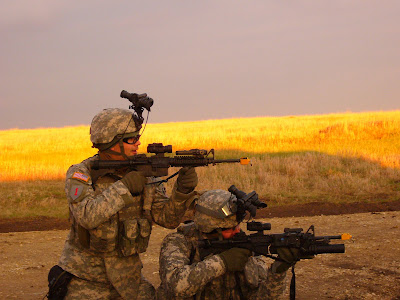
Since we arrived here we have become more and more acclimated to the oppressive heat, temperatures here often reach in excess of 110 degrees. Our first day of training involved us convoying to the desert to conduct a small arms range to confirm our M68 sights were still zeroes to our weapons and to train on reflexive fire and close quarters marksmanship. We arrived at the range about 0430, just as the sun was coming up and stayed out there until after 1530. By 1530 we were all completely fried from the heat, no amount of water, Gatorade or food can maintain your body temperature or chemistry when you are wearing 40 pounds of body armor, longs sleeve shirt and long pants.


Over the next three days we trained on foreign weapons, convoy lane training and finally a convoy live fire exercise. We had the opportunity to shoot AK-47 rifles as well as RPK machine guns, these weapons designed by Kalashnikov are without a doubt the most prolific weapons ever invented. Kalashnikov was a communist who was unable to patent his invention and therefore never profited from its design. The AK-47 is currently manufactured in over 100 countries around the world including the U.S.A number of us have shaved off all of our hair; let me tell you when the wind is blowing sand into every crack and crevice of your body, just being able to pour a bottle of water over your head to wash the sand off seems like a luxury.
Soon we will move up to the Phoenix Academy in Taji Iraq for additional training before we finally arrive in Tal Afar to begin our RIP/TOA (Relief in Place/ Transfer of Authority)Thanks for reading and feel free to leave a comment or two.

Thursday, April 19, 2007

Provincial Reconstruction Teams


A couple posts ago I mentioned how other cabinet departments should get involved, upon further research i found that a few have.

PRTs are mixes of DOD (Army), State Dept, Ag, Commerce etc that are deployed in Iraq and Afghanistan. Here's what I found.


The Graduate Level of Warfare


In the logistics field we often say that amateurs study tactics while professionals study logistics. This week we have been training on what is referred to as "The Graduate Level of Warfare;" Counterinsurgency. If you've pain attention to the news lately you know that General David Petraeus has taken over the helm as the top U.S. General in Iraq. Petraeus was most recently at Fort Leavenworth where he oversaw the publication of the first Counterinsurgency manual written for the Army since the Vietnam Era, FM 3-24. This Manual was co-written by an Officer named LTC John Nagl.

LTC Nagl served in the first Gulf War where he realized that due to our overwhelming success against what was at the time one considered one of the most formidable Armys in the world. He realized that in the future no country would stand toe to toe with us and that the wars of the future would be fought against squad and platoon sized insurgent elements. He attended Oxford University as a Rhode's scholar and completed his PhD on counterinsurgency with a thesis titled "Learning to Eat Soup With a Knife." His book was a study of counterinsurgency in Malaya (British) and Vietnam (U.S.)

Anyway, LTC Nagl came to speak to us today about Counterinsurgency and his talk was very very good. He discussed how the Army has been loathe to change or even realize that it needs to change with regard to this.

The reason counterinsurgency is so difficult is because you have to be able to do everything necessary in traditional warfare, i.e. Artillery, Close Air Support, Logistics, Patrols etc., but you also have a responsibility for public infrastructure, political legitimization, foreign internal defense etc. I encourage any of you to read through the links here and realize just how difficult this is, and consider that the British success in Malaya, considered the textbook case, took 12 years. I'm not sure what that means, for war to continue you need three things, equipment, soldiers and public will, at this point I'm pretty sure we are at best 2/3. The American public just doesn't have the stomach for much more of this, and thats fine.

A couple funny, (ironic?) vignettes from vietnam counterinsurgency:

When General Westmoreland was asked at a press conference what his plan to deal with the counterinsurgency in Vietnam was, he responed "firepower." He was quickly replaced by GEN Creighton Abrams

When General Abrams met his North Vietnam counterpart after the war he told him "you know we never lost a military engagement against you" the NV General told him "that may be true, but it is also irrelevant."

It may take a while to change an organization as big as the Army, there are alot of people who still want to line up all the tanks and fight the communists, they will soon also be irrelevant.


READ THIS, ITS WHAT I'M TALKING ABOUT

Monday, April 16, 2007

33 Dead in School Shooting


That's the headline all across the country tonight as the nation reacts to this unexplained violence. It made me realize how calloused and insulated we have become about the violene in Iraq. Consider this, a massacre on the scale of the one today in VA Tech occurs at least weekly in Iraq yet it barely makes a ripple in the "drive by" news media which informs most of us. Last week when we were debating the racial overtones of "Nappy Headed Hoe's" hundreds of Iraqis and dozens of Americans were killed in Iraq. A recent post of mine linked to a story about a bombing in Tal Afar which proved to be the single deadliest attack since the war begain. Nearly 100 innocent citizens where killed, the Iraqi Police and Iraqi Army exchanged gunfire yet it was in and out of the news in less than 24 hours. Not one reader of this blog (if there are any) posted anything about it. This may be understandable if we weren't involved in this bloodshed, but our occupation and subsequent mismanagement of the war is direcly responsible for it. No one in this country is responsible for what happened today, but dozens of elected and appointed officials are at least indirectly responsible for the chaos in Iraq.
This isn't intended to minimize what happened today, but it does shed some light on how we view the news and how we receive and process information.
Later this week I'll try to post on what I perceive as the lack of participation by other cabinet level agencies in D.C. Imagine the progress that a bit of assisstance from the Ag, Commerce, Transporation, Energy or Health and Human Services departments could stimulate. What is it that the DOD is saddled with this responsibility we are the least trained for it. Driving a HMMWV or wearing Body Armor isn't that hard. And the DOD didn't ask for this war, we were simply ordered to execute it.
Here's some links to some interesting stories from the weekend and a video of a HMMWV being towed back through the creek after it got flooded out.


Monday, April 09, 2007

4 Years Later


Its been four years since the fall of Baghdad, and I would submit that very few Iraqis are better off today than they were before the capital fell. By nearly any measure most of Iraq is in worse condition than at any time in recent history, income, security, basic sanitation, electricity, access to clean water. I guess if you go into something without a plan, its easy to say that your plan didn't fail. Juan Cole has an interesting post on titled "How to get out of Iraq," worth clicking over to. Muqtada Al-Sadr has organized a big rally today

and has urged his Sadr Militia-men to quit targeting Iraqi Soldiers and Policemen and instead focus their efforts on US Forces. Bear in mind that his loyalists votes in the parliament are responsible for Nouri Al- Maliki being in place. So in some ways Al-Sadr is a legitimate politicial figure, imagine if Jesse Jackson or David Duke urged their followers to kill and got away with it... Its happening in Iraq.

We had four days off for Easter Weekend and had some much needed Rest and Relaxation, we're back to training tomorrow and I'll keep you updated on how thats going.

Presidential politics are getting interesting, Hilary and Barak have refused a Fox News Debate, John McCain seems to be staking his success squarely on the success of the troop surge. I generally won't talk much about my thought on politics here, though if you really care leave a comment or two.

Thursday, March 29, 2007

M2 Range


We went to the .50 cal range on Tuesday, we shot both day and night, for the night it was pitch black but we used a thermal scope to engage targets, it was pretty cool. The M2 .50 caliber machine gun shoots a 1/2" wide bullet (hence .50 caliber, one caliber would equal one inch). The gun was introduce in 1933 and is still the weapon of choice for long distance defense and offense, it has been used widely in every war and is still mounted on the most modern aircraft from AH-64 Apache Helicopters to F-18 Fighter jets. Anyway, here's a short video of the weapon being fired at night, the bright spots are tracer rounds going down range.


Not Good News

The city of Tal Afar (my future home) experienced its most violent day in recent memory yesterday, apparantly at one point the Iraqi Police and the Iraqi Army exchanged gunfire, bear in mind that each of these entities has an embedded American Adivsory Team, I'm just glad they weren't caught in the middle.

Wednesday, March 28, 2007

4 WEEKS

We’ve been at Camp Funston now for about a month, and it’s hard to remember all of the training we have undergone. I’ll try to recap the best I can, and I’ll try to do better at keeping this thing updated, believe it or not Internet access may actually improve when I get to Iraq, hopefully the food will as well.
· Language Training: Language classes are usually once or twice a week and are either via an interactive computer game or with an instructor, Arabic is challenging to learn, there are many sounds which are foreign to the English tongue and are challenging to pronounce. So far I can get through about the first five minutes of a conversation. Lately we have been focusing on more specific tactical phrases such as “give me your ID,” “Do you have any weapons” etc.
· Cultural Training: The Iraqi culture or Arabic culture is quite a bit different from our own. Arabic people value honor above all else. If you disrespect someone’s honor, by lying to them, not keeping your word, or disrespecting them in front of their families, it is extremely difficult to regain their trust. This basic fact goes a long way to explaining why we have failed so badly in the battle for “hearts and minds” in Iraq. There are stories of Soldiers entering Iraqi homes, giving the formal greeting of “Aasalaamu Alyekum” literally translated as “Peace be upon you” and then proceeding to trash their home in search of weapons or other contraband. Not great PR by any stretch. Also, Iraqis are not clock driven the way Americans are, if you have a meeting with an Iraqi, regardless of how urgent the matter, you will have tea and small talk for the first 10-15 minutes. Finally, an Iraqi will never tell you no if you ask them for something or to do something, they will instead respond “In Sha Allah” which translates to “God Willing” or “If god makes it happen it will happen, if not, don’t blame me…” Interestingly enough this is why they are poor marksmen with their AK-47’s, they believe that if Allah wants them to kill the target he will ensure that the bullet finds its target, if not, then it wasn’t meant to be.
· Religion: The rift between Sunnis and Shia has been covered thoughrouly in numerous media outlets, Islam is a historically rich religion with a lot in common with both Christianity and Judaism.
· History: It is said that the history of Iraq is the history of mankind, the Garden of Eden is thought to be in between the Tigris and Euphrates rivers, an area also known as the fertile crescent. From the hanging gardens of Babylon to Greek and Roman trade routes to WWI, the area has been the crux of numerous historical events. Although the country of Iraq is a relatively modern concept (Post WWI), the Tribal and Sheikdom system of rule in the area is thousands and thousands of years old. Numerous technologies that we take for granted were developed in this area: Paper, Law (Hammurabi’s Code), Arabic Numerals (based on the rule of 10, as opposed to Roman Numerals which were developed only to track how many Super Bowls have been played.
· Weapon’s Training: We each carry an 9MM Beretta and an M-4 Carbine, we’ve all qualified on both of these weapon systems. The M-4 qualification was particularly interesting, it was the first time I have ever qualified with this type of weapon without using normal “iron” sights. We used the M68 Sight with allows the firer to simply place the dot in his scope on the target and squeeze the trigger, of course it has to be calibrated perfectly to your weapon, and tedious but important process. But once its on it is amazingly simple. Also we shot our M-4s at night using the AN/PEQ Infra-Red Laser Aiming Device. Another remarkable piece of technology when used with the PVS-7B Night Vision Goggles. The PEQ emits an Infra Red Laser which can only be seen with Night Vision Capability. So if you are “painting” a target they won’t even know it, if you have the PEQ zeroed to your weapon all you have to do is put the weapon on your hip and follow your laser beam, when it hits the target you squeeze the trigger. The PEQ also has a an infrared spotlight to mark your position for friendly aircraft and the laser can be used to designate targets for Close Air Support Missions flown by either the Air Force or the Army Aviation Assets.
· IED Awareness, and Prevention: If you know anything about this war, you know that more Soldiers have been killed by IEDs or Improvised Explosive Devices (not really improvised any more but more on that in a minute). We have seen scores, maybe hundreds of videos of American vehicles and Soldiers being targeted by IEDs. The reason the videos are so prevalent is because Insurgents get paid for proof of a successful attack, therefore almost every IED attack is videotaped. So, we learn what the latest Tactics Techniques and Procedures (TTP’s) are out there, and how we can defeat them. Many IEDs are radio detonated by garage door openers, cell phones, key fobs, RC Cars etc. The Army has developed a system to jam these frequencies which I used briefly in my first tour but has been greatly improved since, but I really can’t say more about it for OPSEC reasons. The latest and scariest threat has been what is referred to as and EFP or explosively formed projectile, these are supposedly being manufactured (i.e. not improvised) in a four letter country that borders Iraq, they haven’t been seen up north where I am going yet though.
· Driver’s Training: The Army’s latest improvement on the Highly Mobile Multi-Purpose Wheeled Vehicle or HMMWV (yeah I know there’s an acronym for everything) is the M1114A4, it is an uparmored, heavy suspension turbo-charged vehicle with a crew served weapon (M2 .50 cal or M240 7.62 MM Machine Gun). We’ve received training on operation, maintenance etc. on these vehicles. Also we went through the HEAT trainer (HMMWV Egress Assistance Trainer). I know an acronym within an acronym, welcome to my world. This is a HMMWV with is mounted on at pivot which allows it to be have to escape a flipped HMMWV which is often either on fire or under fire.
· Combat Lifesaver Training: This training instructs soldiers on how to provide immediate care under fire in order to stabilize a soldier long enough for a Chopper to evacuate the casualty to a CASH. It has been estimated that 95% of patients who make it to the hospital alive leave alive, the advances in battlefield medicine in this war alone are probably greater than the difference between the Civil War and Vietnam. We were instructed on how to apply a tourniquet, administer an IV. Initiate a Saline Lock, a saline lock is used to provide access to a patients veins, it is basically a catheter in the vein through which drugs can be administered or an IV can be attached, it is important to initiate this early because as casualties go into shock, blood pressure drops and the veins can collapse and be very difficult to access. Also we learned how to treat a sucking chest wound and perform needle chest decompression, to relieve tension pneumothorax which basically amounts to sticking big ass needle (think 5 inches long) between the ribs of a casualty into the chest cavity and relieving air pressure. I’m trying to upload some videos of this; if I do I’ll link them up here.

I know this has been a long post, and I’ll try to keep them shorter in the future, please feel free to let me know if you’ve visited.

Monday, February 19, 2007

Camp Funston

We finished inprocessing on Friday and moved down to Camp Funston. Camp Funston was previously a National Guard training and living area. Since the MiTT Mission moved to Fort Riley however, they have built new barracks, dining facilities and new offices. Construction is just recently completed however and they haven’t moved into the landscaping, sidewalk building and drainage phase. This wasn’t a problem on Friday when we moved because it was around 8 degrees and everything was under a layer of snow, however over the weekend temperatures were in the 50s and the snow melted and now it is a sea of mud. The POV (privately owned vehicle) parking lot where we park our cars was a grassy field; it is now a muddy muddy mess.
We are living in 30 man open bays with bunk beds. Each man has a footlocker and a wall locker to store all of the gear we were issued which I mentioned in a previous post. Needless to say, living conditions leave a lot to be desired. Imagine 30 pairs of muddy boots tromping through your kitchen everyday, and when it dries up and you try to sweep it up it just creates a dust cloud for about 30 minutes.

Thursday, February 15, 2007

Going To Tal Afar

We found out earlier this week that we will be stationed in the city of Tal Afar, It is a town I became familiar with the first time I was over there. It is the town where SSG Mejia, one of my squad leaders got hit with an IED in this HMMWV. It was in the news quite a bit when the unit that replaced us, COL H.R. McMaster's, (the closest thing the Army has to a Superstar Franchise Officer) Third Armored Cavalry Regiment, built a wall around the whole city and used the strategy of Clear, Hold and Build. If you use Google News or Juan Cole to find out what's been goin on there, you won't find much. So, that's a good thing I suppose. Feel free to dig around in the included links for more information, there's alot of it linked in there, this article from the New Yorker is pretty informative on what McMaster accomplished. Also, his book Dereliction of Duty is considered mandatory reading for the Army's Officer Corps. There's also a large PBS Frontline Online Special containing interviews and videos which I highly recommend.
Peace

Wednesday, February 07, 2007

Inprocessing

Well, I've arrived at Fort Riley, its a bit strange to be here again, considering I was here almost exactly 8 years ago. Its still cold, but a lot of new buildings and facilities. Right now we are in processing, drawing equipment and meeting our teammates. Yesterday I drew 2 full duffle bags of gear at CIF (central issue facility) including my Interceptor Body Armor, (IBA) three pairs of new boots, a ruck sack, gas mask etc etc. Later in the afternoon I drew another full dufflebag full of equipment, including silkweight long underwear, nomex and gortex gloves, oakley sunglasses, dust goggles, and, two more pairs of boots. Also we received our ACH (Advanced Combat Helmet), which, according to the manufacturer...


The MSA Military Advanced Combat Helmet (ACH) delivers the world's most
advanced ballistic and impact head protection, with unsurpassed comfort
for long-term use. The helmet's low-profile design reduces the risk of
interference in target acquisition and ensures compatibility with NVGs
(night-vision goggles), MSA's CBRN (Chemical, Biological, Radiological,
Nuclear) Gas Masks, and MSA's communication devices.


An
innovative suspension system of movable comfort pads (which are
attached to Velcro strips on the inside of the helmet) provides
customized sizing and superior comfort. The sized pads conform to the
shape of your head to distribute the helmet's weight evenly and
comfortably. Simply adjust and move the absorbent pads for a flexible,
personalized fit.


Finally we were issued our M68 CCO, (Close Combat Optic), basically its an unmagnified rifle scope, designed for reflexive close quarters combat, when you look through it there is a red dot visible floating in the middle, wherever your red dot is, that's where the round is going, assuming you have it all zeroed properly.


So, all told, I now have four full duffle bags of gear and I still have another issue scheduled for Friday to include new uniforms etc.


Another interesting station in the inprocessing schedule is called ISO-Prep, or Isolation Preparation. It is designed to build a data base about you that only you know. It is used in case you are captured to ensure that you are who you say you are. We each had to divulge any distinguishing marks, as well as write 4 brief stories or statements which only we would know, for example... "My first dog was a black and white Old English Sheepdog named Ritz, and Aunt Janice hit him with a car and the mailman brought him to our house." So, now theoretically if I am captured, the rescuers my burst in the door and ask which of my Aunts hit my dog, and if I give them the right answer, I can be saved.


powered by performancing firefox

Thursday, January 18, 2007

Are you Ready for the Surge?

How much difference will 21,500 more soldiers make? I guess we'll see. Maliki says if we just give him more guns, we can reduce troops in three to six months. I guess he'll take care of all the Sunni's by then.

Two Republican Senator's have come out publicly against the surge, Senator Chuck Hagel and Senator Olympia Snowe. Not that they have much power to stop it, though they can limit the money spent. Do they dare?

Wednesday, January 03, 2007

The Seven Deadly Sins of Failure in Iraq: A Retrospective Analysis of the Reconstruction

The Middle East Review of International Affairs, December 2006

Kenneth M. Pollack, Director of Research, Saban Center for Middle East Policy

"It never had to be this bad. The reconstruction of Iraq was never going to be quick or easy, but it was not doomed to failure.[1] Its disastrous course to date has been almost entirely the result of a sequence of foolish and unnecessary mistakes on the part of the United States."


1. Ignorance
2. Arrogance
3. Neglect
4. Stubborness
5. Panic
6. Haste
7. Denial


Saturday, December 09, 2006

Monday, December 04, 2006

A Civil War by any other Name Would Still be as Deadly


Not that it matters, or that it would change anything on the ground, but isn't the administrations refusal to classify what is happening in Iraq a Civil War a bit obstinate? Merriam Webster's dictionary defines it as "a war between opposing groups of citizens of the same country" Sounds pretty cut and dried to me. Alot of people seem to agree. Kofi Annan on the BBC, Matt Lauer on the Today Show. Jimmy Carter called it one of our 'greatest blunders' and a civil war. Remember when it wasn't an insurgency either?? As Rumsfeld Said:

"Over the weekend, I thought to myself, 'You know, that gives them a
greater legitimacy than they seem to merit,' " Rumsfeld, at a Pentagon briefing
yesterday, said of his ban on the I-word. "It was an epiphany," he added,
throwing his hands in the air.
Encouraging reporters to consult their
dictionaries, the defense secretary said: "These people aren't trying to promote
something other than disorder, and to take over that country and turn it into a
caliphate and then spread it around the world. This is a group of people who
don't merit the word 'insurgency,' I think."


Saturday, December 02, 2006

Covering His Ass or Pulling His Head Out Of It?


Two days before he resigned as defense secretary, Donald H. Rumsfeld submitted a classified memo to the White House that acknowledged that the Bush administration’s strategy in Iraq was not working. Link To Story Link to the full Memo

So, I wonder, did he know he was going when he wrote it and was he just trying to cover his ass on the way out? Or was he finally pulling his head out of it?

Wednesday, November 29, 2006

Why We Are Where We Are


Article From a Retired One Star Currently Teaching at West Point


Many of our faculty and staff have asked me my views about the current situation in Iraq. A few students have also asked. So I thought I would take this opportunity, two days before Veterans' Day, to provide you with some insights as seen from the perspective of a combat veteran who served as the Commanding General of US and allied forces in Iraq. I also served as Chief of War Plans in the Pentagon and have spent considerable time studying national security affairs, including a fellowship at the National Defense University. So while it's true that everyone has opinions about Iraq, I would argue that not all of those opinions are equally well-informed. This talk will address our strategy in Iraq. I won't talk about what the next steps should be, what the long-term prospects for peace in Iraq are, or how we can best get out of the quagmire we are in. Those might be other talks. For today I'm going to focus on strategy Let me begin by saying that most of our problems in Iraq stem from a flawed strategy that has been in place since the beginning of the war. It's important that you understand what strategy is. In military terminology there is a distinction between strategy, operations, tactics, and techniques. Strategy pertains to national decision-making at the highest level. For example, our strategy in World War II was to mobilize the nation, then defeat the Nazi regime while conducting a holding action in the Pacific, then shift our forces to destroy the Japanese Empire. Afterwards, our strategy was to rebuild both defeated nations into capitalistic democracies in order to make them future allies. An example of an operational decision from World War II would be the decision to invade North Africa and then Italy and Southern France before moving directly for the heart of Germany by coming ashore in Northern France or Belgium. Tactics characterize a scheme of maneuver that integrates the different capabilities of, for example, infantry, armor, and artillery. A technique might describe a way of employing machine guns with overlapping fields of fire or of setting up a roadblock. Our strategy in Iraq has been: 1. fight the war on the cheap; 2. ask the ground forces to perform missions that are more suitably performed by other branches of the American government; 3. inconvenience the American people as little as possible, and 4. continue to fund the Air Force and Navy at the same levels that they have been funded at for the last 30 years while shortchanging the Army and Marines who are doing all of the fighting. No wonder the war is not going well. Let me explain how the war is being fought on the cheap. From the very beginning, Defense Secretary Donald Rumsfeld, who thankfully announced his departure yesterday, has striven to minimize the number of soldiers and Marines in Iraq. Instead of employing the Colin Powell doctrine of "use massive force at the beginning to achieve a quick and decisive victory," his goal has been "use no more troops than absolutely necessary so we can spend defense dollars on new technology." Before hostilities began, the Army Chief of Staff, Eric Shinseki, testified before Congress that an occupation of Iraq would require hundreds of thousands of soldiers. Shinseki made his estimate based on his extensive experience in the former Yugoslavia where he worked to disengage the warring factions of Orthodox Serbians, Catholic Croatians, and Muslim Kosovars. Shinseki also had available the results of a wargame conducted in 1999 that involved 70 military, diplomatic, and intelligence officials. This recently declassified study concluded that 400,000 troops on the ground were needed to keep order, seal borders, and take care of other security needs. And even then stability would not be guaranteed. Because of his testimony before Congress, Rumsfeld moved Shinseki aside. In a nearly unprecedented move, to replace Shinseki, Rumsfeld recalled from active duty a retired general who was more likely to accept his theory that we could win a war in Iraq and establish a stable government with a small number of troops. The Defense Department has fought the war on the cheap because, despite overwhelming evidence that the Army and Marine Corps need a significant increase in their size in order to accomplished their assigned missions, the civilian officials who run the Pentagon have refused to request authorization from Congress to do so. Two Democratic representatives, Mark Udall from Colorado and Ellen Tauscher of California, have introduced a bill into Congress that would add 80,000 troops to the end-strength of the active Army. Currently, this bill has no support from the Defense Department. When I was commissioned in 1969 the Army was one and a half million. Despite the fact that we're engaged in combat in Iraq, in Afghanistan, in the Philippines, and committed to peacekeeping missions in Bosnia, Kosovo, and the Sinai, and on operational deployments in over 70 countries, our Army is now less than one third that size. We had more soldiers in Saudi Arabia in the first Gulf war than we have in the entire Army today. In fact, Wal-Mart has three times as many employees as the American Army has soldiers. As late as 1990, Army end-strength was approximately 770,000. With fewer than a half-million today, defense analysts have argued that we need to add nearly 200,000 soldiers to the active ranks. Today, the Army is so bogged down in Afghanistan and Iraq that fewer than 10,000 soldiers are ready and able to deal with any new crisis elsewhere in the world. And because the Army is so small, after only a year at home units are returning to Iraq for a second and even a third 12-month tour of duty. Let me add a parenthetical note here explaining a difference between our services. Army tours of duty in Iraq are for 12 or 13 months. For Marines it's normally six months. For Air Force personnel it's typically four months. So when a soldier says he's going back to Iraq for his third tour, it means something totally different than when an airman says the same thing. Because the active force is too small, the mission of our National Guard and reserve forces has been changed. Their original purpose was to save the nation in time of peril. Today they serve as fillers for an inadequately sized active force. This change in mission has occurred with no national debate and no input from Congress. We have fought the war on the cheap because we have never adequately funded the rebuilding of the Iraqi military or the training and equipping of the Iraqi police forces. The e-mails I receive from soldiers and Marines assigned to train Iraqi forces all complain of their inadequate resources because they are at the very bottom of the supply chain and the lowest priority. We have fought the war on the cheap because we have failed to purchase necessary equipment for our troops or repair that which has been broken or a worn out in combat. You've all read the stories about soldiers having to purchase their own bulletproof vests and other equipment. And the Army Chief of Staff has testified that he needs an extra $17 billion to fix equipment. For example, nearly 1500 war-fighting vehicles await repair in Texas with 500 tanks sitting in Alabama. Finally, we are fighting this war on the cheap because our defense budget of 3.8% of gross domestic product is too small. In the Kennedy administration it averaged 9% of GDP. The average defense budget in the post Vietnam era, from 1974 to 1994, was about 5.8% of GDP. If we are in a global war against radical Islam, and we are, then we need a defense budget that reflects wartime requirements. A second part of our strategy is to ask the military to perform missions that are more appropriate for other branches of government. Our Army and Marine Corps are taking the lead in such projects as building roads and sewage treatment plants, establishing schools, training a neutral judiciary, and developing a modern banking system. The press refers to these activities as nation-building. Our soldiers and Marines are neither equipped nor trained to do these things. They attempt them, and in general they succeed, because they are so committed and so obedient. But it is not what they do well and what only they alone can do. But I would ask, where are our Department of Energy and Department of Transportation in restoring Iraqi infrastructure? What's the role of our Department of Education in rebuilding an Iraqi educational system? What does our Department of Justice do to help stand up an impartial judicial system? Where is the US Information Agency in establishing a modern equivalent of Radio Free Europe? And why did it take a year after the end of the active fighting for the State Department to assume responsibility from the Department of Defense in setting up an Iraqi government? These other US government agencies are only peripherally and secondarily involved in Iraq. Actually, it would be inaccurate to say that the American government is at war. The U.S. Army is at war. The Marine Corps is at war. And other small elements of our armed forces are at war. But our government is not. A third part of our strategy is to inconvenience the American people as little as possible. Ask yourself, are you at war? What tangible effect is this war having on your daily life? What sacrifices have you been asked to make for the sake of this war other than being inconvenienced at airports? No, America is not a war. Only a small number of young, brave, patriotic men and women, who bear the burden of fighting and dying, are at war. A fourth aspect of our strategy is to fund Navy and Air Force budgets at prewar levels while shortchanging the Marine Corps and the Army that are doing the fighting. This strategy, of spending billions on technology for a Navy and Air Force that face no threat, contributes mightily to our failures in Iraq. Secretary Rumsfeld is a former Navy pilot. His view of the battlefield is from 10,000 feet, antiseptic and surgical. Since coming into office he has funded the Air Force and the Navy at the expense of the Army and Marines because he believes technological leaps will render ground forces obsolete. He assumed that the rapid victory over the Taliban in Afghanistan confirmed this belief. For example, the Defense Department is pouring billions into buying the newest fighter aircraft, at $360 million each, to take on a non-existent enemy Air Force. But, for pilots like Rumsfeld, war is all about technology. It's computers, it's radar, and it's high tech weapons. Technologists have a hard time comprehending the motivations of a suicide bomber or a mother who celebrates the death of her son in such a way. It's difficult for them to understand that to overcome centuries of ethnic hatred and murder it will take more than one generation. It's hard for them to accept that for young men with little education, no wives or children, and few job prospects, war against the West is the only thing that gives meaning to their lives. But war on the ground is not conducted with technology. It is fought by 25-year-old sergeants leading 19-year-old soldiers carrying rifles, in a dangerous and alien environment, where you can't tell combatants from noncombatants, Shiites from Sunnis, or suicide bombers from freedom seeking Iraqis. This means war on the street is neither antiseptic nor surgical. It's dirty, complicated, and fraught with confusion and error. In essence, our strategy has been produced my men whose view of war is based on their understanding of technology and machinery, not their knowledge of men from an alien culture and the forces which motivate them. They fail to appreciate that if you want to hold and pacify a hostile land and a hostile people you need soldiers and Marines on the ground and in the mud, and lots of them. In summary, our flawed strategy in Iraq has produced the situation we now face. This strategy is a product of the Pentagon, not the White House. And remember, the Pentagon is run by civilian appointees in suits, not military men and women in uniform. From the very beginning Defense Department officials failed to appreciate what it would take to win this war. The US military has tried to support this strategy because they are trained and instructed to be subordinate to and obedient to civilian leadership. And the American people want it that way. The last thing you want is a uniformed military accustomed to debating in public the orders of their appointed civilian masters. But retired generals and admirals are starting to speak out, to criticize the strategy that has produced our current situation in Iraq. But, if we continue to fight the war on the cheap, if we continue to avoid involving the American people by asking them to make any sacrifice at all, if we continue to spend our dollars on technology while neglecting the soldiers and Marines on the ground, and if we fail to involve the full scope of the American government in rebuilding Iraq, then we might as well quit, and come home. But, what we have now is not a real strategy -- it's business as usual.

Tuesday, November 28, 2006

Orders in Hand


I guess I'll introduce this BLOG by just laying down some basic facts.

Right now I'm in school in Ft. Lee, VA at the Army Logistics Management College (ALMC) I am attending the Combined Logistics Captains Career Course (CLC3). I will graduate in January.

I am going to Iraq again as a logistical advisor to the Iraqi Army (part of MTT Team or Military Transition Team), while this may sound exciting or interesting (and I'm sure it will be both), there is alot of misinformation about what this actually means for me.

I know that when I graduate from CLC3, I will be assigned to Kuwait for Personnel Accounting Purposes, I will do about 90 days of training in Ft. Riley Kansas prior to going overseas.

A NY Times Article Outlines the Basic Idea


A MTT Team:

1. Consists of a 10-12 Officers and Senior NCO's specializing in Logistics, Military Police, Intelligence, Communication and Combat Arms.

2. Is embedded in an Iraqi Army, Security Police, or Border Patrol Battalion. (Not Sure which I will be a part of yet).

3. Lives, Eats, Trains, Patrols, Learns, Suffers and Survives along with their Iraqi Counterparts.

4. Can Live anywhere in Iraq, from the Kurdish Conrolled North, to the Shiite Controlled South to the volatile and ethnically diverse center.

5. Represents the "Exit Strategy" from Iraq. (If one exists that is)

6. Is the Army Leaderships Top Priority

7. Will be unlike anything I have done in the Army thus far.

Monday, November 27, 2006

Iraq:The hidden story

The story of what does not get reported in Iraq by the mainstream media. This film clip contains graphic imagery, and probably shouldn't be watched if you have a weak stomach or are under the age of 15